
A publishing calendar that survives a busy month
How to plan four weeks ahead without writing four weeks of posts up front.
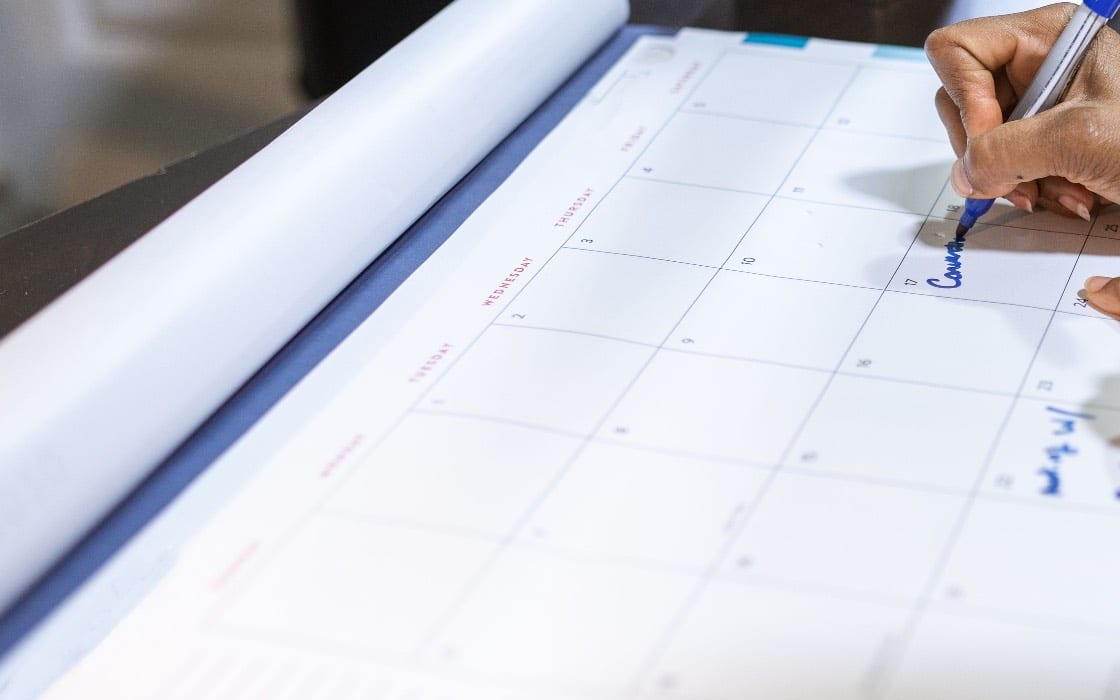
Why the month collapses in week two
Most content calendars are built the same way. Someone blocks out a morning, fills four weeks of a grid with finished ideas, writes as many of them as the morning allows, and calls it a plan. It survives until the first thing that was always going to happen happens — a client wants a campaign by Friday, a launch slips, somebody is off sick — and a week is missed. Because every cell in that grid was a specific finished post tied to a specific day, missing one week does not cost one week. It costs the plan: everything behind it is now slightly wrong, and nobody has another morning to rebuild it.
The mistake is not the planning. It is that each cell was holding two different things and treating them as one — a commitment (we publish on Wednesday) and an artifact (this is Wednesday's post). Commitments should be set far ahead and rarely change. Artifacts should be made as late as you can afford. Put them in the same cell and you inherit the worst property of each: the rigidity of a schedule and the perishability of a draft.
Set the cadence from your worst week
Before deciding what to publish, decide how often — and decide it by looking at your worst month this year rather than your best, because the worst month is the one the calendar has to survive.
Pick the number of slots per week you would still have hit in that month. For most teams publishing for a brand, that is three, not seven. Three slots hit fifty weeks a year beat six slots hit for a fortnight and then abandoned — not because consistency is rewarded by some mystical property of the feed, but because an audience learns a rhythm, and a team that meets its own commitment keeps meeting it.
Give every slot a standing job
A blank cell on a Wednesday is a small research project. A cell that reads “Wednesday: the teaching slot” is a prompt. The job of a standing slot is to reduce the question from “what should we post?” — which has infinite answers and therefore stalls — to “what is this week's version of the thing we always post on Wednesday?”
The jobs that tend to earn their place:
- Proof. Something that happened: a result, a shipped thing, a customer outcome, a number. The hardest slot to fill and the one that does the most work.
- Teaching. One useful thing explained properly, aimed at someone doing the job rather than someone buying the product.
- Point of view. What you believe about your field that a competitor would not write. This is the slot that makes a brand legible.
- Human. The team, the process, the mess. Cheap to make, and the reason anyone follows a company rather than subscribing to its blog.
- Ask. The one that points somewhere — a demo, a download, an event. Rationed: one in five at most.
Four slots and four jobs make a month of planning into sixteen one-line briefs rather than sixteen drafts. That is an hour of work, not a morning, and it can be done a month ahead without going stale.
Brief a month out, write a week out
A week before the month starts — set the month
Pick the theme or campaign the month hangs on, then write one line per slot: the job, the angle, and who it is for. No copy. If a brief needs a paragraph, it is a campaign rather than a post and belongs somewhere else.
Each Thursday — write next week
One session, the whole week, in the order the briefs were written. Four posts written together are faster than four posts written on four days, and the batch is what keeps the voice consistent.
Each Friday — approve and queue
Everything needing a sign-off gets it in one pass, and the approved posts go straight into the schedule. Nothing waits in a drafts folder for somebody to remember it.
Each Monday — look back, not forward
Fifteen minutes on what last week's posts actually did, and one line added to next month's briefs because of it. This is the step people skip, and it is the one that stops a calendar becoming a treadmill.
The gap between brief and draft is the whole trick. A brief written three weeks early is still true three weeks later. A draft written three weeks early is usually slightly wrong by the time it publishes — the news moved, the campaign changed, the number is stale — and rewriting it costs more than writing it would have.
Keep a shelf
Every calendar needs a small shelf of finished posts that are dated nowhere: the explainer that is true all year, the process piece, two or three evergreen teaching posts. Five or six is enough.
The shelf is not filler. It is what turns a bad week from a hole in the calendar into a non-event. The rule that makes it work is that you replace what you take — a post pulled off the shelf on Tuesday is replaced by Friday, or the shelf quietly empties and you find out during the next bad week.
When it slips, drop — never slide
Something will be missed. The instinct is to move everything forward by a day, or a week, so that nothing is lost. Resist it: sliding turns one missed post into a month of posts that are each slightly late, and a schedule nobody trusts.
Drop the slot instead. The commitment was to publish on Wednesday, not to publish that particular post, and a slot missed is a slot missed. Write it off, leave Friday where it is, and the plan is intact on Monday.
Measure the calendar, not the posts
Post count measures effort, not a calendar. The number worth watching is the share of planned slots that published on time. Around eighty per cent or better means the cadence is right. Persistently below it means the cadence is wrong and should be lowered — not that the team should try harder, which has never once worked.
Two other things earn a line in the monthly review: how many posts came off the shelf, since a rising number means the rhythm is under strain, and how far ahead the queue actually sits on a Friday. A queue shrinking towards zero is a warning several weeks before the calendar breaks.
What this looks like in ChaparHub
None of the above needs particular software; a spreadsheet and a shared calendar will hold it. What a hub changes is the number of places the plan lives. In ChaparHub the brief, the draft written from it, the approval, the schedule and the result are one record rather than five — so “what is this week's version of the Wednesday post?” is answered by looking at the same thread that says what last Wednesday's earned. The shelf is the template library, and the Friday approval pass is the queue.
Questions this raises
How far ahead should a content calendar be planned?
Commitments — how often you publish, on which days, and the job each slot does — should be set about a month ahead and then left alone. Finished posts should be written roughly a week ahead. Planning finished posts a month out is what makes a calendar brittle: the drafts go stale, and one missed week invalidates everything behind it.
How many times a week should a brand publish?
As often as it can in its worst week, which for most teams is three to four times rather than daily. A cadence that survives a busy month is worth more than a higher one that collapses, because the cost of stopping is larger than the gain from any individual post.
What should you do when you miss a scheduled post?
Drop it and leave the rest of the schedule where it is. Sliding every later post forward turns one missed slot into a month of late posts and a plan the team stops trusting. The exception is a dated campaign post, which moves as a unit or not at all.